

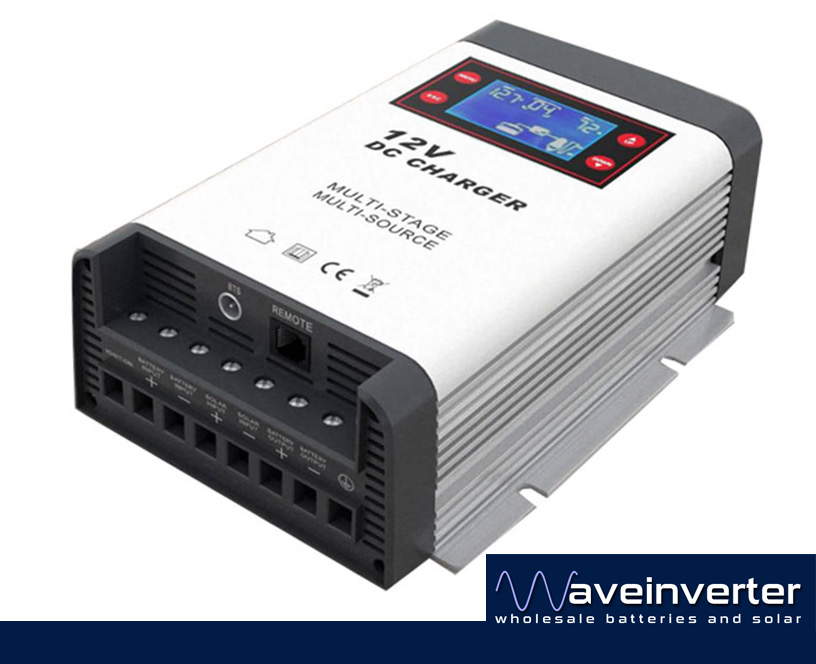

12V 45A Carspa DC DC Smart Charger
12V 45A DC to DC charger with PWM solar built in, up to 600W of panel. Lead acid or lithium, and it only draws above 12.9V so the vehicle still starts.
$435.00 incl GST
Description
| 12V Battery Input |
| Input Voltage | 12.9-16 VDC | |||
| Low voltage shut down | <12.5VDC After 2 minutes, if the voltage of charger is under 12.5V, the charger will shut off.If the voltage goes under 12.0VDC, the charger will shut off immediately | |||
| Low voltage recovery | ≥13.0 VDC | |||
| Over voltage shut down | ≥15.8 VDC | |||
| Over voltage recovery | ≤15 VDC | |||
| Solar Input | ||||
| Input voltage | 15-40V(Open circuit voltage) | |||
| Low voltage shut down | ≤15 VDC | |||
| Low voltage recovery | ≥15.5 VDC | |||
| Over voltage shut down | ≥45 VDC | |||
| Over voltage recovery | ≤44 VDC | |||
| Power of solar panel | 600W Max | |||
| Output voltage | 12 VDC(nominal voltage ) | |||
| Output current | 45A Max | |||
| Battery type | GEL | AGM | WET | Lithium / program(Custom settings) |
| Constant voltage | 14.2 VDC | 14.4 VDC | 14.6 VDC | 13.8-14.8 VDC(settable) |
| Float charging voltage | 13.6 VDC | 13.8 VDC | 14 VDC | 13-14.2 VDC(settable) |
| Charging current | 45A default adjustable to 10/15/20/25/30/35/40/45A | |||
| Charging mode | 3-stage | |||
Self Recoverable from Over Temperature: temperature>65℃, the charger will shut down; temperature <55℃, the charger will start to charge again Cooling Fan: Automatic Temperature and Load Controlled Dimensions: 225 x 165 x 77 mm Net Weight: 2.1 KG
Specifications
| Battery voltage | 12V |
|---|---|
| Charge current | 45A, adjustable down through 40, 35, 30, 25, 20, 15 and 10A |
| Charging stages | 3 stage: constant current, constant voltage, float |
| Absorption voltage | 14.2V GEL, 14.4V AGM, 14.6V wet, 13.8 to 14.8V settable for lithium |
| Float voltage | 13.6V GEL, 13.8V AGM, 14V wet, 13 to 14.2V settable for lithium |
| Charges | Conventional Flooded Lead Acid, Calcium, AGM VRLA & GEL and Lithium batteries |
| Suitable bank | 40Ah to 1200Ah |
| Input range | 12.9 to 16V from the starter battery, and it only draws above 12.9V so the vehicle still starts. Shuts down below 12.5V after two minutes and immediately below 12V, recovers at 13V. Over voltage shutdown 15.8V, recovery 15V |
| Solar array voltage | 15 to 40V open circuit, 600W of panel maximum. Shuts down below 15V or above 45V, recovers at 15.5V and 44V |
| Cooling | Automatic fan, temperature and load controlled |
| Protection | Self recovering over temperature: shuts down above 65°C and restarts below 55°C |
| Size | 225 x 165 x 77 mm |
| Weight | 2.1 kg |
| Warranty | 12 months return to base |
Common questions about battery chargers
What size charger do I need?
Work from the battery bank, not from the charger. For lead acid types, charge at 5 to 20 percent of the bank's amp hour capacity, so a 200Ah bank wants somewhere between 10 and 40 amps. For lead carbon you can go harder, 5 to 33 percent.
On top of that, every battery model has a maximum charge current, use it as a hard ceiling rather than a guideline. Those are listed model by model on the battery charging page.
Too small and the bank never finishes. Too big and you cook it. Tell us the bank and we will match a charger to it.
Can I charge the house battery from the vehicle while I drive?
Somewhat but not properly with just a cable, no. A plain alternator puts out roughly 14.0 to 14.1V, and that cannot complete the staged charge a deep cycle battery needs, so the bank starts every day already low and sulphates over months.
What does the job is a DC-DC charger. It takes whatever the alternator gives it and produces a real multi-stage charge at the right voltage for your battery chemistry, and it isolates the house bank from the starter so you cannot flatten the one you need to get home.
Can one unit do the alternator and the solar?
Yes, and it saves you a box. Our 20A DC-DC charger has an MPPT solar controller built in, so the vehicle charges the bank while you drive and the panel takes over when you stop, with one set of battery settings instead of two devices arguing about the voltage.
Will it charge lithium?
Some will and some will not, and it matters more than with lead acid. Lithium wants a different voltage profile, no float stage, and it must not be charged below freezing.
We stock chargers with a proper lithium setting from 3A up to 50A, in 12V, 24V and 48V. Check the product page for the model you are looking at, because a lead acid charger on a lithium bank either will not fill it or will sit there holding a float voltage it should not.
Do you do 48V chargers?
Yes, from 1A up to 40A, including lithium and lead carbon models.
48V is where most people run out of options locally, so if you cannot see the size you want, ask. We do not list everything we can supply.
What do the charging stages mean, and is seven better than three?
Three stage is bulk, absorption, float: fill it fast, hold it at the absorption voltage until it is actually full, then drop back to a holding voltage. That is the part that matters and a good three stage charger will look after a battery for years.
The extra stages on a seven stage charger are things like a soft start on a very flat battery, a desulphation pulse, an analysis step and a periodic top up. They are useful on a bank that gets abused or left standing, and they are not what decides whether your battery survives. Getting the voltage and the current right is.
What is reverse pulse charging, and does it actually do anything?
It puts a brief discharge pulse into the charge cycle, which helps break down the sulphate crystals that build up on a plate when a battery spends time part charged. On a tired bank it can recover capacity. On a healthy one it is maintenance rather than magic.
It is not a substitute for charging properly. A battery that never reaches its absorption voltage will sulphate faster than any pulse can clear.
How long will it take?
Roughly the amp hours you need to put back, divided by the charger's amps, plus about a third again for the absorption stage, which slows down on purpose as the battery fills.
So a 200Ah bank down to 50 percent needs about 100Ah back. At 20A that is five hours of bulk and closer to seven all up. The last 20 percent always takes longer than people expect, and skipping it is what kills banks prematurely.
What voltage should it be charging at?
It depends on the battery, not the charger. Every model line has its own absorption range, treat it as a hard ceiling you must never pass, and also its own float voltage, and they are set out line by line on the battery spec sheet and on our charging page.
Get it wrong on the low side and the battery simply never fills, which is the most common way a good deep cycle battery gets killed. Put a multimeter on the terminals and check the charger is actually delivering what it claims.
Can I leave it connected all the time?
Yes, on anything with a proper float stage, which is everything we sell. That is what float is for: it holds the battery full without boiling it.
Worth knowing what it does not do. A battery on float is not being exercised, and a bank that never cycles will still age. If it is a standby bank that is fine and expected. If it is a house bank, use it.
Not covered here? Tell us the bank and we will match a charger to it.
Additional information
| Shipping weight | 4 kg |
|---|
