


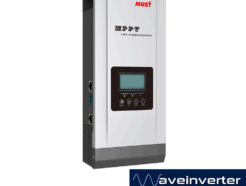
MUSTPOWER 12/24/48V 80A MPPT Solar Charge Controller
MPPT solar controller, 80A at 12V, 24V, 36V or 48V. Up to 4640W of panel at 48V, for lead acid, gel or lithium. Sits between the 60A and the 100A.
$899.00
Description
Specifications
| Controller type | MPPT |
|---|---|
| Charge current | 80A |
| Battery voltage | 12V, 24V, 36V or 48V, automatic detection |
| Maximum array | 1160W at 12V, 2320W at 24V, 4640W at 48V |
| Solar array voltage | operating 16 to 95V at 12V, 32 to 130V at 24V, 48 to 130V at 36V, 64 to 130V at 48V |
| Charges | Lead acid, gel and lithium |
| Charging stages | 4 stage, charging voltages adjustable on the unit |
| Idle draw | under 15mA |
| Monitoring | LCD showing charge voltage, charge current, battery voltage, battery capacity and output current, with LED status indication |
| Cooling | Fan |
| Protection | Output short circuit, battery low voltage, PV array short circuit, PV reverse polarity, battery reverse polarity, over charging |
| Size | 293 x 151 x 84 mm |
| Weight | 3.1 kg |
| Warranty | 12 months return to base |
Common questions about charge controllers
MPPT or PWM, which one do I need?
PWM just connects the panel to the battery, so the panel is dragged down to battery voltage and everything above that is lost as heat. MPPT converts the extra voltage into extra charge current instead.
The rule of thumb: if the panel's voltage is close to the battery's, PWM is sufficient and a cheaper solution. A 36 cell "12V" panel whose actual voltage is ~18V on a 12V battery is the classic case. If the panel runs well above the battery, which is any modern 60 or 72 cell panel, you want MPPT, and the difference is not small.
MPPT also earns its keep in the cold and in weak light, because that is exactly when panel voltage is high and current is low.
What size controller do I need?
Divide the array's watts by the battery voltage. 600W of panel on a 12V bank is 600 ÷ 12, so 50 amps, and you would fit a 50A controller. The same 600W on a 48V bank is only about 13 amps.
That is why going to 24V or 48V costs you less in controller and cable than staying at 12V. It is the single cheapest decision in the whole system and it has to be made first, because everything downstream follows from it.
If you are not sure what you will end up with, tell us the panels and the bank and we will size it.
Can I put a big house panel on a 12V battery?
Yes, with MPPT. A 60 or 72 cell panel puts out roughly 30 to 45V and a PWM controller would throw most of that away. MPPT turns it into current.
What you must check is the controller's maximum PV open circuit voltage, and leave real room under it. Panel voltage rises as temperature falls, so a string that measures fine on a warm afternoon can go over the limit on a frosty morning. Going over it, even slightly, will break the controller. We deliberately quote a working figure below the datasheet maximum for that reason.
How many panels can one controller take, and do I wire them in series or parallel?
The controller has two ceilings, and you have to stay under both: the maximum array watts for your battery voltage, and the maximum PV open circuit voltage.
Series adds voltage and keeps current the same. Parallel adds current and keeps voltage the same. Series is usually the better answer because it lets you use thinner cable over a long run, right up until it pushes you near the voltage ceiling. Then you go to two shorter strings in parallel.
Shading changes this. A shaded panel in a series string pulls the whole string down, so if part of the roof goes dark in the afternoon, split the array.
Can I use a solar charge controller on a wind turbine?
No, and it is the most expensive mistake in this category.
A turbine puts out three phase AC at a voltage that climbs with wind speed, so it has to be rectified before anything can use it. That is the easy part. The hard part is that a turbine must never be left with nowhere to send its power. Once the battery is full, a solar controller simply stops taking current, which for a panel is harmless and for a turbine means it is now unloaded, free to overspeed, and it can destroy itself in one gust.
A wind controller instead dumps the surplus into a resistive load, called a dump load, and can brake the turbine. That is what you are paying for.
What does a wind controller do that a solar one doesn't?
Three things. It rectifies three phase AC into DC. It runs a dump load, so surplus power always has somewhere to go. And it can short the turbine's phases together to brake it, which is how you stop the machine to work on it or to ride out a storm.
The MPPT function matters more on wind than on solar, because a turbine's output voltage swings with wind speed across a much wider range than a panel's ever will.
Can I run wind and solar into the same battery bank?
Yes, and it is a good combination in New Zealand, because the windy days are generally the ones the sun is not doing much.
Use a separate controller for each source, both wired to the same bank. Do not try to feed a turbine and an array into one controller unless it is specifically built for both. The bank is the buffer that ties the two together, which is the right way to think about the whole system: generation on one side, consumption on the other, and the battery in the middle acting as a buffer and absorbing the difference.
Will it charge lithium?
Check the model. Lithium needs a different profile from lead acid: a different absorption voltage, and no float in the lead acid sense. A controller with a selectable or user-programmable profile will do it, a fixed lead acid one will not do it properly.
The bigger point is that on lithium the controller has to cooperate with the battery's BMS. If the BMS disconnects on a fault while the array is producing, the controller must survive losing its battery. Ask us before you pair a controller with a lithium bank.
What fuses and breakers does it need?
Two places, and they do different jobs. Between the battery and the controller, sized to the controller's rating, because the battery is the thing that can deliver hundreds of amps into a fault. Between the array and the controller, which matters once you have more than two strings in parallel, because one faulty string can otherwise be back-fed by the others.
Use DC rated devices. An AC breaker of the same number will not reliably clear a DC fault, since DC has no zero crossing to help the arc go out.
My panels are 400W, so why am I only seeing 250?
Usually nothing is wrong.
Panels are rated at 1000W per square metre, 25°C cell temperature, straight on. Real roofs in real weather rarely see all three at once, so 70 to 80 percent of the rating on a good day is normal.
The other common answer is that the battery is nearly full. Once the bank is in absorption or float, the controller deliberately backs off the amp rate, and what you are watching is not the array's limit but the battery's. If you want to know whether the array is genuinely underperforming, look on a clear morning with the bank down at 50 percent, not at midday with it full.
Not covered here? Tell us the panels and the bank and we will size a controller for you.
Additional information
| Shipping weight | 7 kg |
|---|

Reviews
There are no reviews yet.