

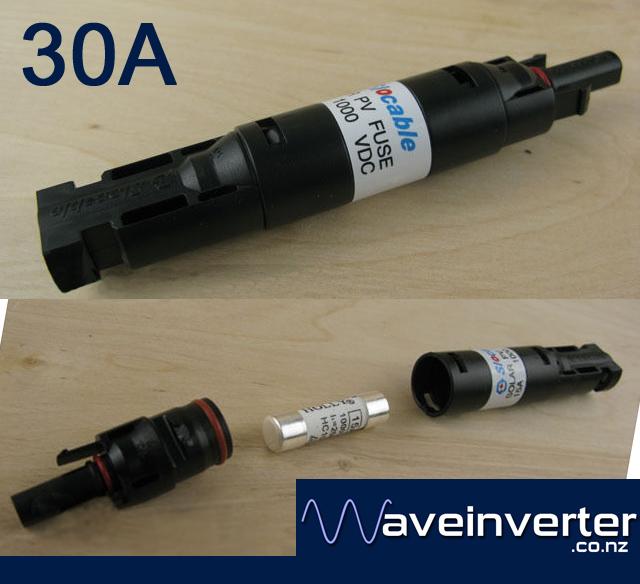
30A PV Solar Panel Fuse (MC4)
Inline 30A PV fuse for the positive wire of a solar string. 1000V DC, TUV Rheinland certified, snaps into the MC4 line in seconds.
$37.00
Description
Specifications
| Maximum continuous current | 30A |
|---|---|
| Voltage rating | 1000V DC |
| Fits | MC4 |
| Supplied with | One pair, one male and one female |
| Standards | TUV Rheinland certified |
| Warranty | 2 years |
Common questions about solar connectors
What size fuse do I need for my array?
Not off the panel's rated current. Off the number printed on the panel's own label, usually called the maximum series fuse rating. That number is set by what the panel itself can survive being back fed. It is a maximum not a target.
The fuse is not there to protect the panel from your load. A string can only ever push its own short circuit current, which is barely more than its maximum power current, so a fuse sized on the load would sit there forever and never blow. What it is protecting against is the other strings. Put four strings in parallel and short one of them, and the other three all feed that fault at once. That is the current the fuse has to be capable of breaking.
We stock 10A, 20A and 30A. Tell us the panel model and how many strings and we will tell you which one.
How many panels can I parallel through one branch connector?
Count amps on the output leg, not panels. Paralleling does not change voltage, it adds current. Two strings pulling 9A each at peak power is 18A coming out of that branch, three is 27A, and these are rated 30A, so that is your ceiling.
The same math catches people on the cable. The leads from the string down to the branch carry only that string's current, but everything after the branch carries the lot, and that leg often has to go up a size. Sizing the array leads properly and then running the combined output back down the same 4 mm2 is a common safety issue we see.
If the sum is past what one branch will carry, move to multiple branch connectors.
Size the leg after the branch with the DC voltage drop calculator
Can I unplug a panel or a string without turning anything off?
No. Never pull an MC4 apart while the array is making current. Cover the panels, do it at night or switch your solar isolator.
An MC4 is a connector, not a switch, and it was never built to be one. DC does not cross zero the way AC does, so once an arc starts between the two halves as they separate there is nothing to put it out. And that arc keeps burning for as long as the sun is on the panels. It will wreck both halves and it can set light to whatever it is lying on.
Isolate first. That is exactly what the DC isolator switch is for. It is built to break that current, it is rated to do it, and it locks off so nobody switches the array back on while your hands are in the system. Turn it off first, then unplug.
Do I crimp these or solder them?
Either. These are the solid copper bar type, so both work, and that is the reason to buy them over the winged crimp only sort.
Crimping is faster and it is what most installers do, but it wants the right die for the barrel. A crimp done with ordinary pliers is the classic cause of a connection that tests fine on the day and is running warm two summers later. If you have not got a proper crimper, solder it.
Either way the gland still has to be done up properly onto the cable, and that is what the MC4 spanner is for. Finger tight is not tight. An unsealed gland lets water down inside the barrel, and that is what has finished off most of the connections we have seen that have failed.
Should I get the two pole or the four pole isolator?
Count arrays, not poles. Both switch positive and negative, which is what you want on a DC array, and both are 32A at 1000V, IP66 and lockable. The two pole does one array. The four pole does two separate arrays in the one box.
The two pole costs more than the four pole and that is not a mistake. It comes with MC4 tails already fitted to both sides, so it plugs straight into your array leads and you never open the box. The four pole you open and wire yourself.
One array and you want it plug and play, take the two pole. Two arrays, or you are happy wiring it, take the four pole.
Can I use these with the connectors already on my panels?
Yes, if they are genuine MC4. That is what the standard is for, and it is why nearly every panel sold here comes fitted with them.
The thing worth knowing is that two halves from different makers are not a tested pair, even when they click together and feel right, because the seal and the contact pressure are only guaranteed between halves designed together. You cannot avoid one such joint where our lead meets your panel's inbuilt factory lead. What you can do is make every other joint in the run out of the same parts, which is why the connectors, the branches and the leads here are all tested to work well together.
Not covered here? Tell us what your panels are and how you want them wired, and we will tell you what connectors and fuses to order.
Additional information
| Shipping weight | 0.2 kg |
|---|

Reviews
There are no reviews yet.