

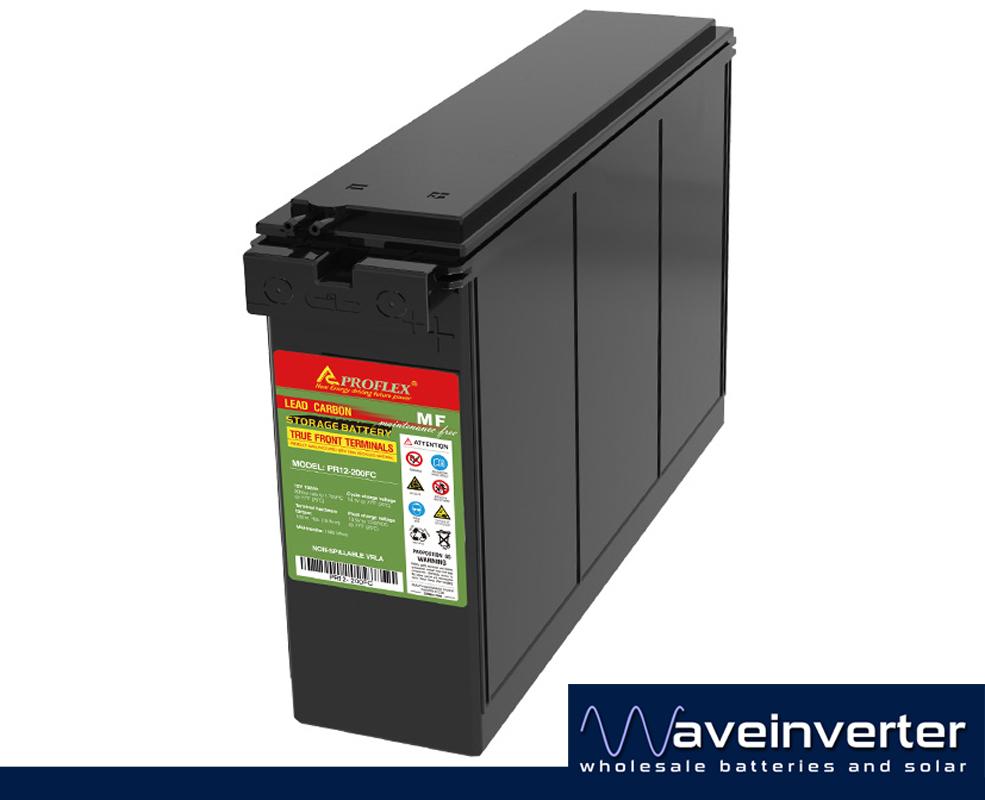


12V 200AH PROFLEX LEAD CARBON BATTERY 7Yr WARRANTY
Lead carbon deep cycle battery, built for heavy daily cycling.
6000 cycles at 30% DoD.
4000 cycles at 50% and 1500 at 80%.
$1,299.00
Description
PROFLEX LEAD CARBON deep cycle battery is a convenient 12V slim form compact unit. Providing you with an extremely high cycle energy storage solution.
This 2nd generation Lead Carbon deep cycle battery by Proflex increases cyclic life even further than 1st generation Lead Carbon Batteries and Lithium Batteries. Unlike other Lead Carbon batteries, Proflex battery charging voltages match low voltage AGM or GEL battery setting, allowing them to be used with a widely available range of inverters and inverter chargers available. Also Partial State of Charge (PSOC) wear is minimal. PSOC wear is a form of extra wear that occurs on your battery when it does not get to be charged up to 100% before being discharged again. This is an issue with traditional Lead acid type batteries.
DoD Deep Cycle AGM Proflex 2nd Gen Lead Carbon
30% 1500 cycles vs 6000 cycles 4x
50% 650 cycles vs 4000 cycles 6x
80% 375 cycles vs 1500 cycles 4x
In the design of long life energy and solar systems our starting point using these is designing to have average of 50% DoD instead of 25% compared with deep cycle AGM. Fast charge ability allows you to safely charge Proflex batteries 2.5 times as fast as traditional Lead Acid types.
I live next to our warehouse in Kelston with my two young daughters, and would never leave a lithium battery charging overnight in the warehouse while we slept next door. I could never recommend to my customers to have Lithium batteries in their homes and have them charge and discharge unattended. I am very comfortable with these batteries charging close to where my children sleep and hence very happy to recommend to my customers to use in their homes and vehicles.
Battery Technology: Lead Carbon Super capacitor Valve Regulated Lead Acid (VRLA) battery with Absorbed Glass Mat (AGM)
Volts:12V
Capacity: 200 Amp-Hours (100 Hour discharge)
Length: 558 mm
Width: 125 mm
Height: 328 mm
Weight: 60 kg
Max Charging Current: 120A
Terminal Type: T11 (for M8 bolts)
Absorption Stage Charging Voltage: 14.3V @ 25C
Float stage Charging Voltage: 13.6V @ 25C
Temperature compensation is: -3mV/℃/cell
Absorption stage Charging Voltage at 15C is 14.48V, at 25C is 14.3V , at 35C is 14.12V.
Specifications
| Battery technology | Lead Carbon Super capacitor Valve Regulated Lead Acid (VRLA) battery with Absorbed Glass Mat (AGM) |
|---|---|
| Nominal voltage | 12V |
| Capacity (100 hour rate) | 200 Ah |
| Cycle life | 6000 cycles at 30% DoD, 4000 at 50%, 1500 at 80% |
| Max charging current | 120A |
| Absorption voltage | 14.3V at 25C |
| Float voltage | 13.6V at 25C |
| Terminal type | M8 bolt |
| Weight | 60 kg |
| Warranty | 7 years |
Common questions about deep cycle batteries
E2, E2 Ultra, E2 Ultra G2 or C2 Carbon, which one do I need?
The difference between them is cycle life, not capacity. A 100Ah battery from any of these lines holds the same 100Ah. What changes is how many times you can take it down and fill it again before it's finished.
E2 for standby duty and gentle cycling, around 1500 cycles at 30% depth of discharge. E2 Ultra for deeper daily cycling, around 2000. E2 Ultra G2 where you want the most cycles we do in a standard AGM, around 2600. C2 Carbon where the bank spends its life part charged or has to recharge fast, 4500 cycles and 0 to 80% in two hours.
If you're cycling every day, work out the cost per cycle rather than the cost per battery. The answer often isn't the cheapest one on the shelf.
How deep can I discharge it?
To any depth. That's the honest answer, and it surprises people who have been told 50%.
Every battery type wears with use, and for every type that wear goes up as the depth of discharge goes up. There is no cliff at 50%, there's a curve. A bank that only ever comes down 20% will outlast the same bank taken to 80%, and both are perfectly legitimate designs. We design systems that discharge anywhere from 10% through to 100%, depending on what the job actually needs.
The cycle figures above are all quoted at 30% depth of discharge, so the lines can be compared against each other on the same basis.
What charging voltage does it need?
Every line we sell has its own absorption range, its own hard ceiling you must never go past, and its own float voltage. Each model also has a maximum charge current, which is a different thing again and just as easy to get wrong.
They're all set out, line by line and model by model, on the battery charging page.
Get the voltage wrong on the low side and the battery simply never fills. That's the most common way a good deep cycle battery gets killed, and it happens over months rather than minutes, so nobody notices until the capacity has gone.
How do I tell how charged it is?
Rest it and measure it. Voltage under load, or straight off the charger, tells you very little.
Disconnect it and leave it a few hours so the surface charge disappears, then measure across the terminals. 12.9V is 100%, 12.6V is 70%, 12.4V is 50%, 12.2V is 30% and 11.6V is 10%.
If you want a real answer rather than a snapshot, fit a shunt based battery monitor. It counts the amp hours going in and out instead of estimating from voltage, and on any serious bank it pays for itself by stopping a deep discharge you didn't know was happening.
How long will it last?
Two different numbers, and they get mixed up constantly.
Design life is how long it survives sitting on float not doing much, and the E2 is built for ten years of that. Cycle life is how many discharge and recharge cycles you get out of it, and that's the figure in the table on this page.
Which number applies to you depends entirely on the job. A standby bank behind an inverter is living on design life. A motorhome bank used frequently lifespan is limited on cycle life and will use them up at whatever rate you cycle it.
What actually decides the outcome is whether the battery gets a full charge regularly. A battery that never quite fills will sulphate and die early, whatever the label says.
Can I use it to start my engine?
The Nomad E2 has high cold cranking amps and people do run it as a dual purpose battery in a boat or a motorhome. The CCA figure for this model is in the table above.
It will work. A dedicated deep cycle house bank kept separate from the starter is still the more reliable setup every time, because the two jobs want opposite things from a battery. If you want a backstop, fit a changeover switch so the house battery can be brought onto the starter when something has gone wrong. That's a useful plan B, not a design.
On a small runabout an upsized dual purpose AGM is fine. On anything larger, or anything you sleep aboard, separate the two banks.
Can I add this to the batteries I already have?
Mixing old and new is possible and we have designed banks that do it, but it depends on the condition and the configuration of what's already there. This is advanced work. If you don't have access to that expertise, avoid it, because it goes wrong quietly and takes the new battery down with the old ones.
Mixing chemistries is a firmer no. AGM, lead carbon and lithium want different charge profiles and they discharge differently as well. We have built systems in that configuration, but it's rare and it is designed rather than assembled.
Tell us what you already have and we'll tell you whether it's worth it.
Why not just go lithium?
Lithium is lighter and gives more cycles. It's also dearer up front, it hates being charged at low temperatures, and it needs charging voltages and a BMS matched to it. Treat one wrong and it can catch fire.
For a shed, a bach or a boat where weight isn't the constraint, a well sized lead carbon bank often wins on total cost, compatibility, safety and robustness. That isn't us avoiding lithium. We sell lithium chargers, our DC-DC units have a lithium setting, and we do stock smaller lithium models where light weight is the point. It's what we'd fit ourselves for most New Zealand off-grid and RV jobs.
What size charger do I need for it?
For lead acid types, C20 to C5. That means charging at 5% to 20% of the bank's amp hour capacity, expressed as charge amps. For lead carbon, C20 to C3, so 5% to 33%.
On top of that each model has a maximum charge current, which is a hard ceiling rather than a guideline, and it's listed against every size we do on the battery charging page.
Tell us the bank size and we'll match a charger to it.
My battery goes flat too fast, or never seems to reach full. Why?
Nearly always one of three things. The bank is undersized for the load, it's aged and sulphated, or it never gets a full charge in the first place.
The third is the common one, and the usual culprit is an alternator. A plain alternator puts out roughly 14.0 to 14.1V, which cannot complete the staged charge a deep cycle battery needs, so the bank starts every day already low. A DC-DC charger, or a proper multi-stage mains or solar charger, fixes it.
Put a multimeter on it and check that the correct absorption voltage is actually reaching the battery, and that it stays there for a decent length of time. That one measurement answers most of these.
Not covered here? Tell us what you are running and we will size the bank for you.
Additional information
| Shipping weight | 63 kg |
|---|

Reviews
There are no reviews yet.