


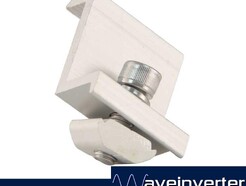
End Clamp Kit 35 mm
End clamp for a 35 mm panel frame, to AS/NZS 1170. Goes at the outside edge of the array, where there is a panel on one side only.
$4.40
Description
AS/NZS 1170
Specifications
| Standards | AS/NZS 1170 |
|---|
Common questions about roof mounting
Which clamp size do I need, 35, 40 or 50 mm?
It is the thickness of your panel frame, not the size or the wattage of the panel. Measure the thickness of the aluminium frame at the edge of the panel, or read it off the panel datasheet, and buy the clamp that matches. We stock 35 mm, 40 mm and 50 mm. If you are getting the panels from us as well, tell us which ones and we will send the clamps to suit.
What is the difference between an end clamp and an inter clamp?
Where it sits and what it grips. An end clamp holds one panel and bolts down at the outside edge of the array, so it has a panel on one side only. An inter clamp sits between two panels and holds both at once, one lip on each side. You cannot swap one for the other. An end clamp at a join leaves the next panel unheld, and an inter clamp on the outside edge has nothing to grip on the empty side.
How many clamps does my array need?
Count the joins. A row of panels sits across two rails, so each panel is held at four points. The panels at each end of the row need an end clamp on each rail, which is four end clamps for the row however long it is. Every join between two panels needs an inter clamp on each rail, so two per join. Four panels in a row is four end clamps and six inter clamps.
Which rail length should I buy?
Whichever crosses the roof with the fewest joins. We stock 2100 and 3405 mm. Add up the widths of the panels in the row, then allow a gap at each join for the inter clamp and a bit at each end. Where the row is longer than one rail, the splice kit joins two rails end to end to extend the run.
Will this fit my roof?
It is made for a metal roof, which is most of New Zealand. The aluminium tin interface kit and the adjustable front leg both fix to long run metal roof. Tile, membrane and standing seam all want a different foot, so ask before you order rather than after. Tell us the roof type, the pitch and how many panels and we will list what the array needs.
Do I need the adjustable legs?
Only if the roof is not already at the angle you want. On a pitched roof facing roughly north the panels usually go flat to the roof on feet (the Aluminium Tin Interface kit) and rails, and there is nothing to adjust. On a flat or low pitch roof, or one facing the wrong way, the rear legs tilt the array up and the front leg holds the lower end down. Three ranges, 15 to 30, 20 to 40 and 30 to 60 degrees. Open and closed lengths are on each leg's page.
Does the array frame have to be earthed?
Yes. The frame is a large piece of metal on your roof carrying DC current, and it gets bonded back to earth, so faults in this solar array and lightning take a direct path to earth rather than through equipment or a human being. Array earthing is part of AS/NZS 5033, the same installation standard the solar cable is made to. The aluminium grounding lug bolts to the rail and takes the earth cable. The 4 mm2 earth cable and the 2000 mm rod with its brass clamp are in the Solar Cabling category.
What does AS/NZS 1170 actually mean here?
It is the loading standard in New Zealand and Australia, the one that sets the wind, snow and other loads a structure has to carry. On a roof array the load that matters is from wind. A panel is a flat sheet a metre or more across sitting in clear air, and in a gale it is trying to lift off, not press down. Mounting made to 1170 is built for that. How close the feet are and how the rails are spanned matters as much as the parts do, so if you are on an exposed site tell us and we will space it sufficiently for the wind.
Can I install this myself?
The mounting, usually yes, if you are comfortable working on a roof and you get the fixings into something solid. The wiring is the part less likely to be yours. Grid connected work, and anything above extra low voltage, is a registered electrician's work in New Zealand (though there are some exceptions for a homeowner to do the work on their own home). An off grid 12V or 24V system charging a battery is a different matter. If you are not sure which side of the line your job falls on, tell us what you are building and we will say.
Not sure what your roof needs? Tell us the roof type, the pitch and how many panels, and we will list the parts for you.
Additional information
| Shipping weight | 0.2 kg |
|---|---|
| Dimensions | 10 × 10 × 10 cm |

Reviews
There are no reviews yet.