


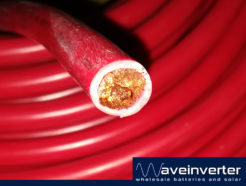
High Current Heavy Battery Flex Cable 95 mm2 950 Amp
95 mm2 flexible welding cable, 950 amps continuous, sold by the metre. 18 mm overall, 750V, AWG 000. For the heaviest battery to inverter runs.
$69.00
Description
High strand count, flexi cable (welding cable), designed for transferring high current DC power with minimal power loss. We use this for transmitting power long distances from wind and hydro turbines or transferring very high currents within vehicles e.g. 100’s of amps 10+ metres, and other demanding applications. Use this battery cable when you need to transfer DC power with minimal voltage drop. Maximum continuous Amp through put is 950 Amps.
Pricing is per metre
Specifications
| Maximum continuous current | 950A (never exceed) |
|---|---|
| Conductor size | 95 mm2 |
| AWG | 000 |
| Sold as | Per metre |
| Overall diameter | 18 mm |
| Voltage rating | 750V |
| Operating temperature | Up to 70°C |
| Standards | 227IEC02, 60227IEC02, GB5023.3-97 |
| Colours | Red and black |
Common questions about battery cable
How many amps can this cable carry?
Roughly the maximum is 10 amps per mm2 of copper at 20°C, so 16 mm2 carries 160 amps, 25 mm2 250, 50 mm2 500 and 95 mm2 950. That figure is on the spec table above for this cable.
That is the heating limit and it is not usually what limits you. On a DC run the voltage drop over the length is the restriction, not the raw current carrying capacity, so a cable that will not overheat can still be far too small for the job.
What size cable do I need?
It depends on three things: the current, the length of the run, and what the cable is feeding. A charging run wants about 1 percent voltage drop or the battery never finishes its absorption stage. Battery to inverter about 2 percent. A non-critical light will live with 7.
Put your own numbers in and it will tell you which size holds up.
What is this size in AWG?
16 mm2 is AWG 5, 25 mm2 is AWG 3, 35 mm2 is AWG 2, 50 mm2 is AWG 0 and 95 mm2 is AWG 000. The AWG number for this cable is on the spec table above.
The two systems do not line up exactly, so the nearest AWG size is always a little larger or smaller than the metric one. 1/0 AWG is 53.5 mm2 and the cable you buy is 50 mm2.
Do I need a single cable or a pair?
A pair, one red one black, for anything needing a positive and a negative: a battery to an inverter, a bank to a busbar, a controller to a battery.
A single where you are only bridging one leg, which is most often putting a circuit breaker, a shunt or an isolator into a circuit that already exists.
Is welding cable the same as battery cable?
For this job, yes. The flexible cable we sell by the metre is welding cable: a high strand count so it bends into tight spaces instead of fighting you, with the same copper cross section as anything else at that size.
It is what we use ourselves for battery to inverter runs and for getting power out of wind and hydro turbines.
Why are the made-up cables soldered as well as crimped?
Every connection adds resistance, and resistance on a high current DC circuit turns into heat and lost volts. Soldered connections are what make a low loss, high reliability cable that will serve you for years without degradation, corrosion or wear.
They cost more to make. It is the reason they last.
How long should I make the run?
As short as you practically can. Voltage drop is proportional to length, so halving the run halves the loss, and it is usually cheaper to move the inverter than to buy the next size up in cable.
If the length is fixed, size up and check the number rather than guessing.
Not sure which size your run needs? Work it out with our DC voltage drop calculator, or tell us what you are wiring and we will size it for you.
Additional information
| Shipping weight | 1.7 kg |
|---|

Reviews
There are no reviews yet.