


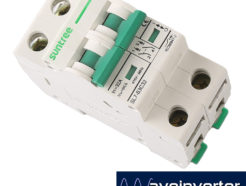
Suntree 25A 2Pole AC Circuit Breaker OffGrid
25A two pole AC breaker for a DIN rail, 415V and 6kA. Made to IEC 60947-2 for outdoor and harsh use, not the indoor switchboard standard.
$17.50
Description
Specifications
| Model | SL7-63N |
|---|---|
| Maximum continuous current | 25A |
| Voltage rating | 415V AC |
| Poles | 2 |
| Breaking capacity | 6kA |
| Service life | 8000 electrical operations, 20000 mechanical |
| Mounting | DIN rail |
| Operating temperature | -5 to 40°C |
| Size | 80 x 71 x 35 mm |
| Weight | 0.24 kg |
| Standards | IEC 60947-2, SAA certified |
Common questions about circuit breakers
Where do the breakers go, and how many do I need?
Most off grid systems want three, in three different places, and none of them is optional.
The first sits between the battery bank and the inverter. That breaker is not there for the inverter, it is there for the cable running to it. The Nomad Circuit Breaker bolts straight onto that cable and needs nothing else. On a larger bank the Suntree SM1 does the same job and across both poles.
The second sits between the solar array and the charge controller, which is where the two pole PV DC breakers belong. If your array is wired as more than one string, each string wants its own, either by separate circuit breaker or an inline PV fuse on each string.
Anything on the AC side of the inverter then gets an AC breaker sized for that circuit rather than for the inverter.
The DIN rail breakers need something to sit in. The fireproof distribution box takes 6 DIN, which is three two pole breakers, and we hold 2 DIN and 12 DIN sizes as well. The larger Suntree breakers are surface mounted and will go in the 250 mm enclosure if you want more protection than that.
Do I size the breaker against my load, or against my cable?
Both, and in that order. Work from the maximum current you expect to flow under normal circumstances, then make sure the cable you are running will carry at least that much.
The cable half is the one people miss. A breaker is there to stop the cable becoming the fuse. A 25 mm2 battery cable carries 250A and no more, so protect it with a 300A breaker and the cable is glowing long before the breaker notices anything is wrong. Every battery cable on this site has its own maximum continuous current on its page, marked never exceed, and the breaker belongs at or below that figure.
What you should not do is inflate the circuit breaker rating because the sum came out higher than you expected. These breakers carry many times their nominal rating for an extended period before they trip, so a figure that looks low on paper will still give you full use of the inverter's wattage capability. And ask yourself which of the two you would rather be replacing, a breaker or an inverter.
What size breaker does my solar array need?
The same rule, applied to a different maximum. On the solar side the current you expect under normal circumstances is the array's short circuit current, not its rated output, because a panel makes more than its label figure on a cold bright day and that is a normal day, not a fault.
Short circuit current is on the panel's own datasheet, usually written Isc. Work out what goes through that breaker, allow for the strings running in parallel, then step up to the next size in the range, which runs 10A to 63A in the two pole PV DC breakers.
How much margin you leave above Isc is set by the standard your installation is certified to, and that is a question for whoever is signing it off. Tell us the panel, how many there are and how they are wired, and we will advise you which one to fit.
What do 6kA and 25kA mean, and does it matter?
That is the breaking capacity, and it is the number that decides whether the breaker survives doing its job.
Its nominal current rating is what it can carry all day. The breaking capacity is the largest fault current it can interrupt and still be a breaker afterwards. What specifies its requirements is not your load; it is what your battery bank can push into a short circuit.
So the two numbers come from two different places. The nominal amp rating comes from the current the circuit will carry pulled by your load. The breaking capacity comes from the size of the bank. Put at least a 6kA breaker on a large battery bank (lead over 400Ah, lithium over 200Ah). Underneath this size, a 3kA breaker is sufficient.
The Nomad NMCB range is 3kA, rated to the automotive and marine SAE J1625. The Suntree DIN rail breakers are 6kA and the SM1 is 25kA, both to IEC 60947-2. If your bank is over the sizes above, the SM1 is the one to fit, and if you are not sure what your bank can deliver into a short circuit, tell us what it is and we will tell you which of the three to use.
My breaker keeps tripping. What is wrong?
Start by ruling out the thing everybody assumes first, which is that the breaker is too small. It usually is not. These carry well above their rating for a long time before they trip, so a correctly chosen breaker does not sit there nuisance tripping on a load it was bought for.
Check every terminal instead, twice. A loose or corroded connection makes its own heat right beside the sensing element, and that will trip a breaker with nothing else wrong with it. Tighten them properly and feel them again once the system has been running, let it move through a couple of thermal cycles and then check for tightness again.
Then look at where it is mounted. The DIN rail breakers are rated to 40°C ambient, and a sealed box in full sun goes past that easily. Give it air, or move it somewhere shaded.
If both of those come up clear, take it seriously. A breaker that starts tripping on a circuit that was fine for two years is telling you something has changed, and the job is to find out what that is, not to fit a bigger one.
Can I use the breaker as an everyday on and off switch?
The Nomad yes, and the Suntree DIN rail ones yes. This is ok to do occasionally.
Keep in mind a protective device is not a service switch and switching under load is hard on the contacts. If you want something to operate every day, use a specialist isolator switch. For example, on solar use one of the PV DC isolator switches in the Solar Connectors category. Those are rated for that job and a breaker is not.
Not covered here? Tell us what the cable is and what it feeds, and we will advise you which breakers to fit.
Additional information
| Shipping weight | 0.3 kg |
|---|

Reviews
There are no reviews yet.