

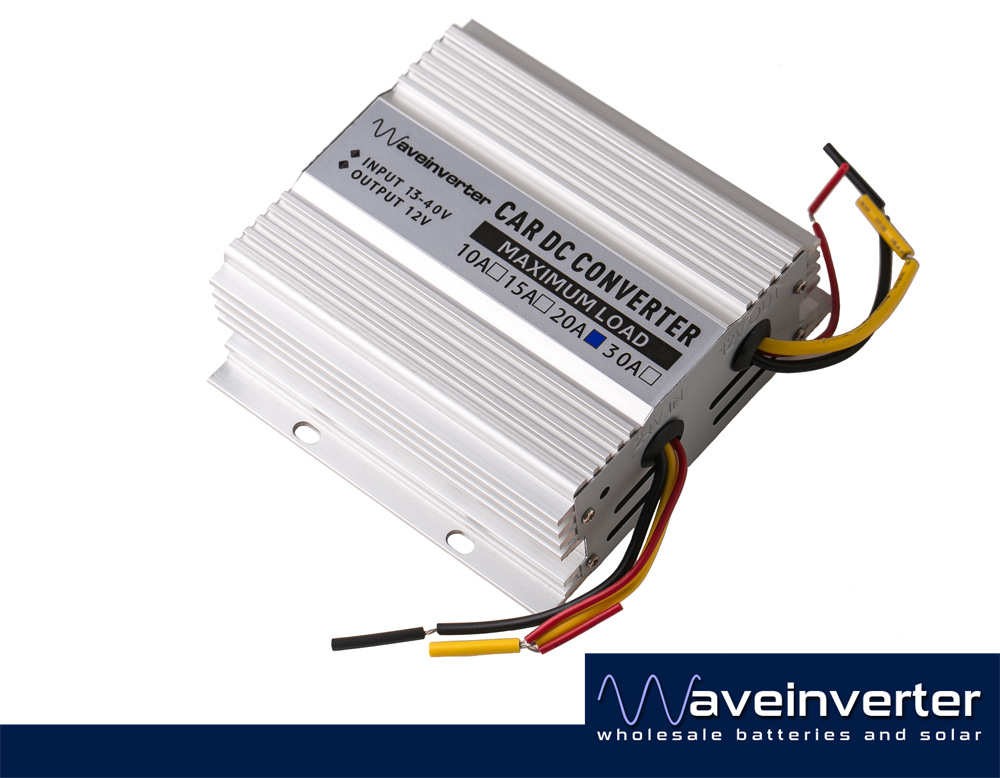

24V to 12V DC 20A Step-Down Converter
Runs a 12V circuit from a 24V supply.
20A continuous.
Aluminium case with mounting holes, fits behind a dash or under a bunk.
$51.00
Description
Use this converter to run a 12V circuit from a 24V supply. It is the smallest of our 24V to 12V range and the one most people want: enough for lights, a radio, a fridge or a pump, without paying for capacity you will not use.
Our customers fit these in boats, trucks, cars and motorhomes all over New Zealand, usually where the vehicle is 24V and the accessories are not.
The case is aluminium with mounting holes, and it has overheating and over-current protection built in.
Do not exceed 240W (20A) through this converter.
Specifications
| Input range | 24V DC |
|---|---|
| Input system voltage | 24V |
| Output | 12V |
| Continuous output | 20A |
| Maximum load | 240W |
| Size | 112 x 110 x 43 mm |
| Weight | 0.3 kg |
| Protection | Over-temperature, over-current |
| Warranty | 12 months return to base |
Common questions about DC converters
Does the converter put out 12V or 13.8V, and does the difference matter?
Both are normal and both run 12V equipment. A 12V system isn't sitting at exactly 12.0V in service anyway, it moves around as the battery charges and discharges, and most 12V gear is built to cope with the range of voltages from that. 13.8V is roughly where a healthy 12V system sits while it's being charged, so some models output that deliberately.
Check the spec table for the exact output of the model you're looking at. Some loads do run better off 13.8V, and the manufacturer or supplier of that equipment will advise you. Otherwise tell us what it is and we'll confirm before you buy.
Will this run my 12V gear off a 24V, 48V or 72V supply?
Yes, that's exactly what it's for. A step-down converter takes a source voltage supply and gives you a stable 12V circuit to run lights, radios, fridges, pumps and the rest. Customers use these in boats, trucks, forklifts and motorhomes every day. The only thing you really have to get right is the amp rating.
What amp rating do I need?
In general add up everything that will be running on the 12V side at the same time, then allow plenty of headroom on top for startup surge. If your gear is listed in watts rather than amps, the watts to amps question below has the sum. We stock from 3A up to 120A, so the range is rarely the problem, knowing your actual load is.
If you're not sure what your loads add up to, tell us what you're powering and we'll size it for you. That's the question we ask everyone anyway.
Can I charge my battery with a DC converter? It seems to be a cheaper way to do things?
No, don't do that. A converter only changes voltage. A charger applies a staged charging profile, bulk, absorption and float, and that's what actually fills a battery safely. Use a plain converter instead and it won't charge your battery fully, and you can break the converter doing it, as the load a battery puts on the converter is uncontrolled and unpredictable.
It looks like the cheaper option right up until you've damaged the battery and the converter both. If you want to charge one battery from another, or from an alternator, you require a DC-DC charger, not a converter.
Can I mount my DC Converter outside, and what happens if it gets wet?
Some models are sealed and rated IP68, and those are fine in an exposed position. Most aren't, so check the product page before you mount one outside.
Even on a sealed model, treat it as rain and splash, not immersion. Don't submerge it, don't aim a hose at it, and don't mount it somewhere it will sit in standing water. Give it a sheltered spot with some air around it and it will last a great deal longer.
Will this work on a positive earth system?
No. These converters can't be used in positive grounded applications.
Nearly everything built in the last sixty years is negative earth, where the battery's negative terminal is bolted to the chassis, and that's what these are made for. Positive earth still turns up on older tractors, some vintage vehicles and the occasional boat.
If you're not sure which you have, look at which battery terminal runs to the chassis or the engine block. If it's the positive one, don't fit one of these. Talk to us first and we'll work out what will suit.
Why does my motor or pump trip the converter when the amps look right?
Because a motor draws far more on startup than it does once it's running. A pump or a winch that settles at 20A can pull well above that for the moment it starts, and the converter sees that surge, not the running figure on the label.
So size on the surge, not the running amps. Your converter has to be big enough for your maximum load including that startup draw. On larger DC motors, where the demand can exceed what a single converter can supply, you may need two units in parallel, and we've done exactly that where one converter couldn't carry the start.
The amount of surging does vary quite a bit. To give you a more extreme example, on motors that are acting on an incompressible fluid, such as a water pump, we have seen surges up to seven times the nominal amp rate of the motor.
How do I work out the amps I need from my appliance's watts?
Divide the watts by the voltage. Power = Volts x Amps, so by rearranging the formula we can find out what the amps are: Amps = Watts / Volts.
A 350W load on a 12V circuit is 350 divided by 12, which is about 29A, so you'd choose a 30A or a 40A unit. Do that for everything that runs at the same time, add the results together, then leave headroom for startup surge, which the motor and pump question above explains. If the label already gives you amps, use that figure specifically.
Can I run several 12V things off one converter?
Yes, and that's a common way to do it. One converter supplies a 12V load circuit and everything on that circuit is powered from it.
What matters is the total, not the biggest single item: add up everything that could be drawing at once. Fuse the 12V side conservatively and size your cable for the current, because 12V cable is a lot thicker than people are expecting for the same amount of power.
Do you have 36V, 72V or 80V input, or an output that isn't 12V?
We do a good deal more than the common 24V to 12V. There are models for 48V, 72V and 80V inputs, a wide-input 20V-60V unit, 48V to 24V, and step-up converters that go the other way, taking 12V up to 24V or 48V.
What we don't hold in stock is low-voltage outputs such as 5V. If you can't see your combination on the site, ask us, because we don't list everything we can supply and a non-stock model is usually about 7 to 10 days.
Not covered here? Tell us what you are powering and we will size it for you.
Additional information
| Shipping weight | 0.3 kg |
|---|

Gizem –
Do you have schematic of this regulator?