


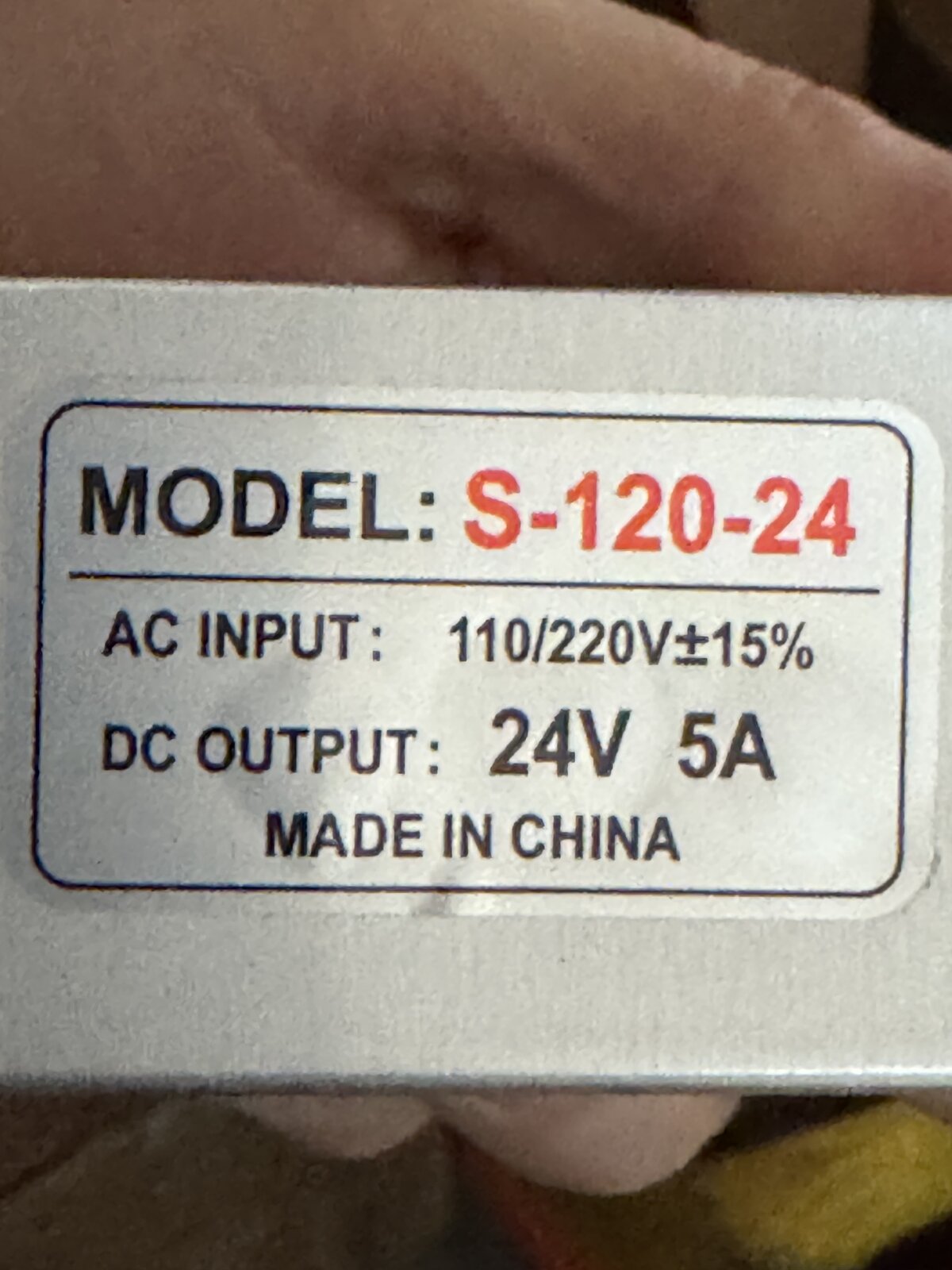
AC to 24V 5A DC Power Supply
Mains to 24V DC, up to 5 amps, 120 watts. Adjustable output. Same work as a 12V 10A at half the current.
$49.00
Description
Specifications
| Model | S-120-24 |
|---|---|
| Output | 24V |
| Continuous output | 5A |
| Maximum load | 120W |
| Output adjustment | Trim pot |
| Input range | 110 to 220V AC, ±15% |
| Terminals | 2 pairs |
| Sealing | None, indoor use only |
| Cooling | Convection, no fan |
| Size | 200 x 97 x 41 mm |
| Warranty | 12 months return to base |
Common questions about power supplies
How far can I adjust the output voltage?
Every supply in the range is adjustable on a trim pot except the 5V 40A, which is fixed at 5V. That lets you set the output to suit the gear you're running.
What size do I need, and how do I work out amps from watts?
Size it on the current your load actually draws, not on what the label on the gear says it can draw. If your gear is rated in watts, divide by the supply voltage to get amps: a 60W device on 12V pulls 5 amps, the same device on 24V pulls 2.5.
Add up everything that will be running at the same time and leave yourself headroom on top. A supply held flat out all day runs hot and won't last as long as one that isn't. If your total lands close to a size, take the next one up.
Can I plug this into a wall socket?
No. These are enclosed supplies with screw terminals, not plug packs, so there's no plug and no lead on them. Mains goes in on terminals at one end and DC comes out the other, and they're made to be mounted in a cabinet or on a panel and wired in.
The mains side needs connecting by someone competent to do it. If that isn't you, get an electrician.
Can I use one of these to charge a battery?
Not properly. A power supply holds one voltage. A charger moves its voltage through bulk, absorption and float as the battery fills, and it's that sequence that gets a battery full without cooking it. Leave a plain supply connected to a battery and it will sit at whatever you set it to forever.
You can use one to hold a battery up, or to run a bench test, but if you want to charge a battery buy a charger.
Is this the same thing as a transformer, an AC adapter or a PSU?
Same job, different words. PSU is just short for power supply unit. An AC adapter or plug pack does the same conversion in a moulded plastic case with a lead and a plug on it, which these don't have. A transformer strictly means the older heavy iron sort, and these are switch mode, which is why they're a fraction of the size and weight of the thing that used to do this job.
If what you want is DC out of a mains socket, this is the category.
Which ones have a fan, and how noisy are they?
Five of the range are fan cooled: the 5V 60A, the 12V 40A, the 12V 83A, the 24V 20A and the 24V 42A. The rest are convection cooled with no moving parts and are silent. Every product page says which it is, on the Cooling line of the specifications.
The fan cooled ones are not generally suitable for having on a desk next to you if you are sensitive to fan noise. Put those in a cabinet, under a bench, or anywhere the noise doesn't matter.
Can I mount it outside, or in a shed or an engine bay?
Indoor only. There's no sealing on any of them, which is what the Sealing line on every product page means when it says none, indoor use only. They're open metal cases with ventilation slots and screw terminals you can touch.
A shed is fine if it's dry and the supply is mounted in a cabinet. An engine bay is not.
Can I run two together to get more current?
Yes, you can in general. Please ask us if you intend to do this so we can advise you correctly on the best way to do it.
Not covered here? Tell us what you're powering, what voltage it needs and how many amps it draws, and we'll tell you which supply fits.
Additional information
| Shipping weight | 2 kg |
|---|

Reviews
There are no reviews yet.